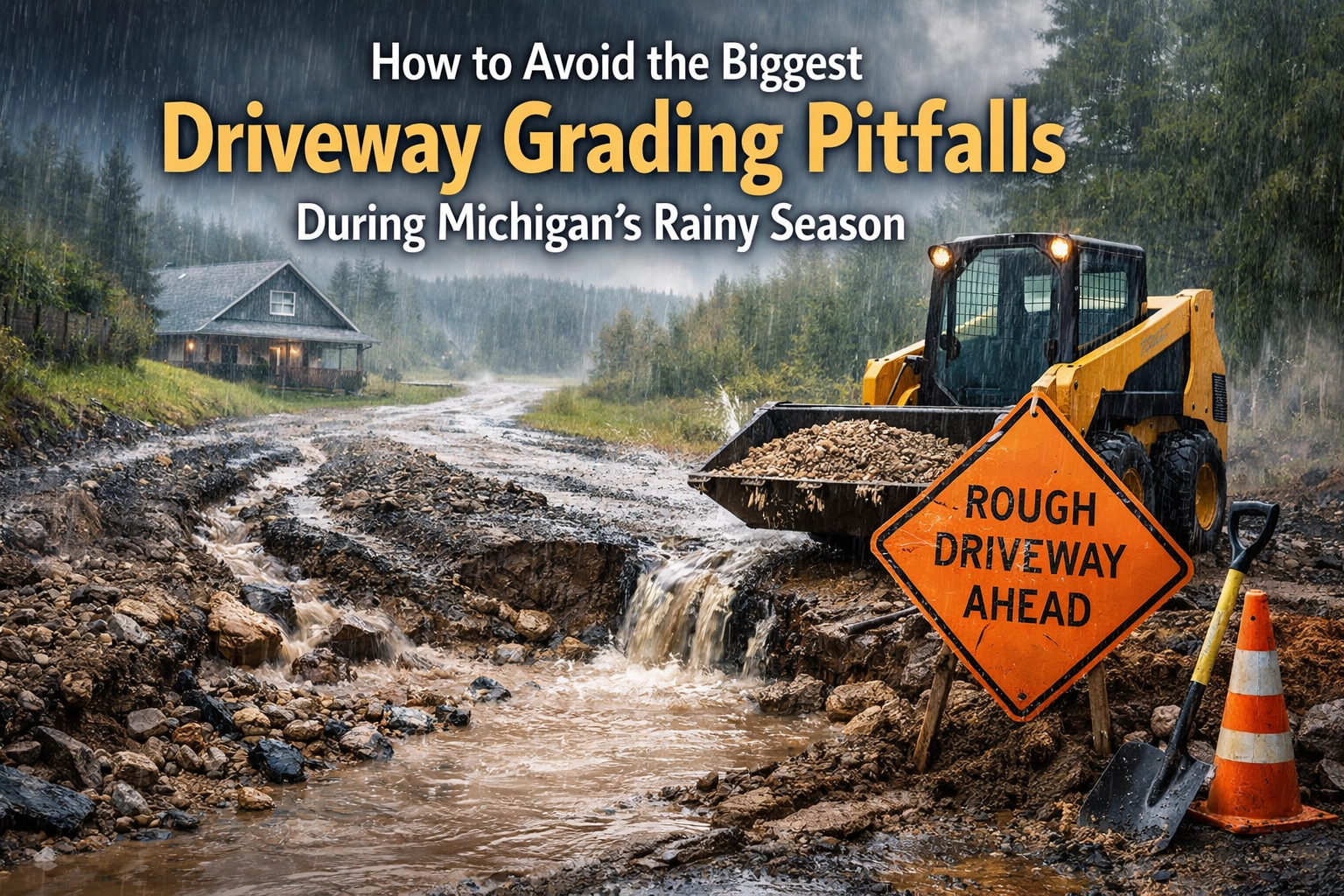
For Michigan property owners, the transition between seasons often brings more than just a change in temperature; it brings a significant challenge to the structural integrity of residential and commercial access ways. The Great Lakes State is notorious for its "mud season," a period where heavy rainfall and thawing ground create a volatile environment for any unpaved surface. When it comes to maintaining a functional, aesthetically pleasing property, understanding the nuances of driveway grading is not merely a matter of convenience: it is a critical component of long-term land management.
Poorly executed grading can lead to catastrophic erosion, costly washouts, and persistent standing water that compromises the very foundation of your driveway. At B & G Outdoor Services, we specialize in providing unparalleled grading services in Clarkston, MI, ensuring that your property remains resilient regardless of the forecast. To help you navigate these seasonal challenges, we have outlined the most common pitfalls and the professional strategies required to avoid them.
The High Stakes of Michigan’s Rainy Season
The primary adversary of any driveway is uncontrolled water. In Michigan, the combination of spring showers and high water tables can quickly turn a minor dip into a major trench. When water is allowed to sit or flow haphazardly across a driveway, it saturates the base material, leading to potholes and "soft spots" that can swallow vehicle tires and make transit nearly impossible.
Securing professional grading services in Clarkston, MI, is the first step in mitigating these risks. A well-graded surface ensures that water is shed efficiently away from the driving path, protecting the subsurface and preventing the expensive cycle of constant gravel replacement.
Pitfall #1: The Danger of Improper Timing
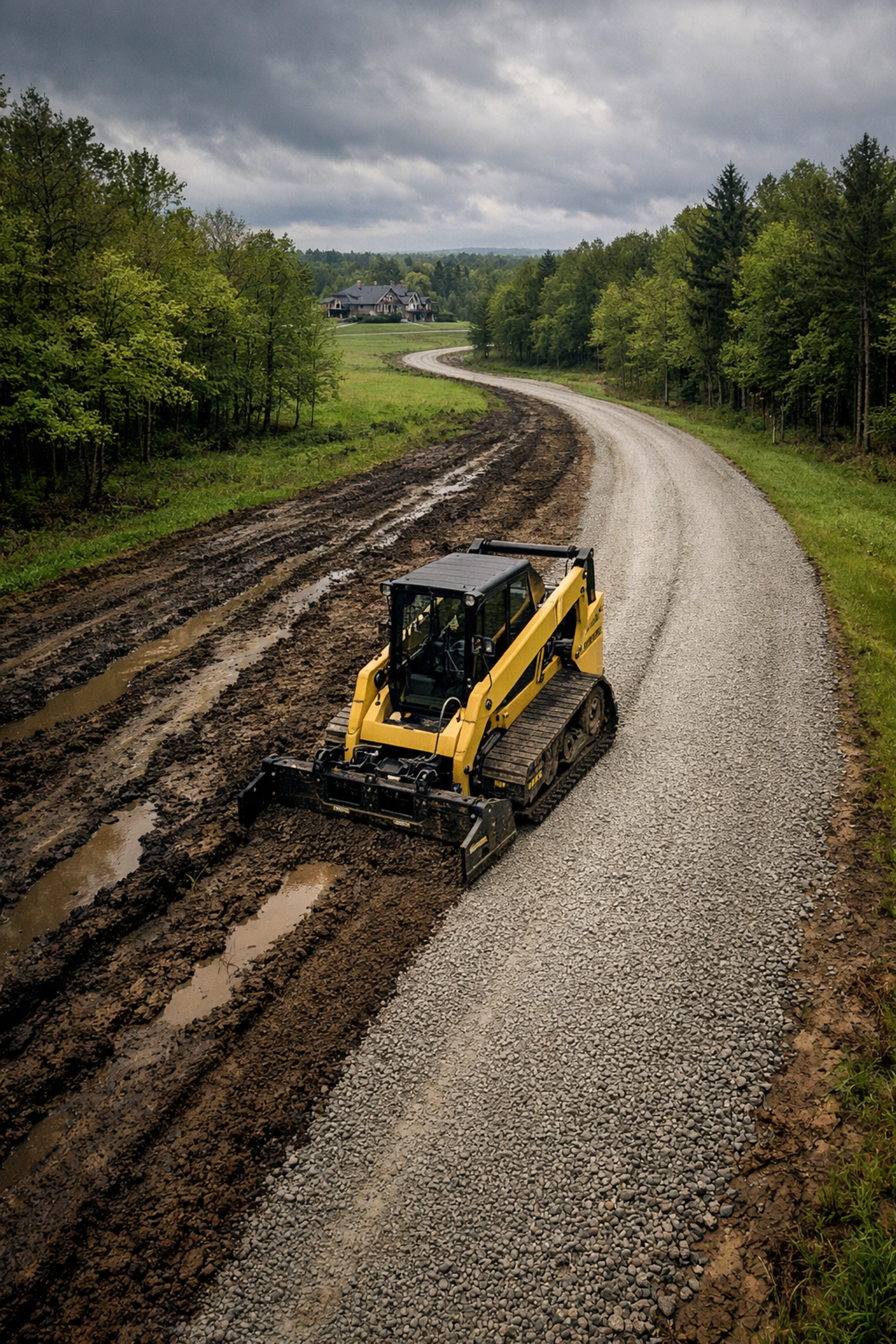
One of the most frequent errors property owners make is attempting to grade a driveway during the height of the rainy season or when the ground is excessively saturated. While it may seem intuitive to "fix" a muddy driveway while it is muddy, this is often counterproductive.
Why Wet Grading Fails
When the ground is too wet, heavy machinery: even state-of-the-art equipment: can do more harm than good. The soil and aggregate lose their load-bearing capacity, causing equipment to sink and create deep ruts that are difficult to smooth out. Furthermore, wet material cannot be properly compacted. Without compaction, the newly moved gravel remains loose, meaning the very first rainstorm after the "fix" will simply wash the material away again.
The Professional Strategy
The skilled team at B & G Outdoor Services recommends scheduling grading when the ground has thawed but is firm enough to support equipment. Ideally, grading should be performed in the late spring after the initial thaw or in the early fall before the winter freeze. This allows for optimal moisture content in the soil: just enough to help the material bind together, but not so much that it becomes a slurry.
Pitfall #2: Neglecting the "Crown" and Drainage Slopes
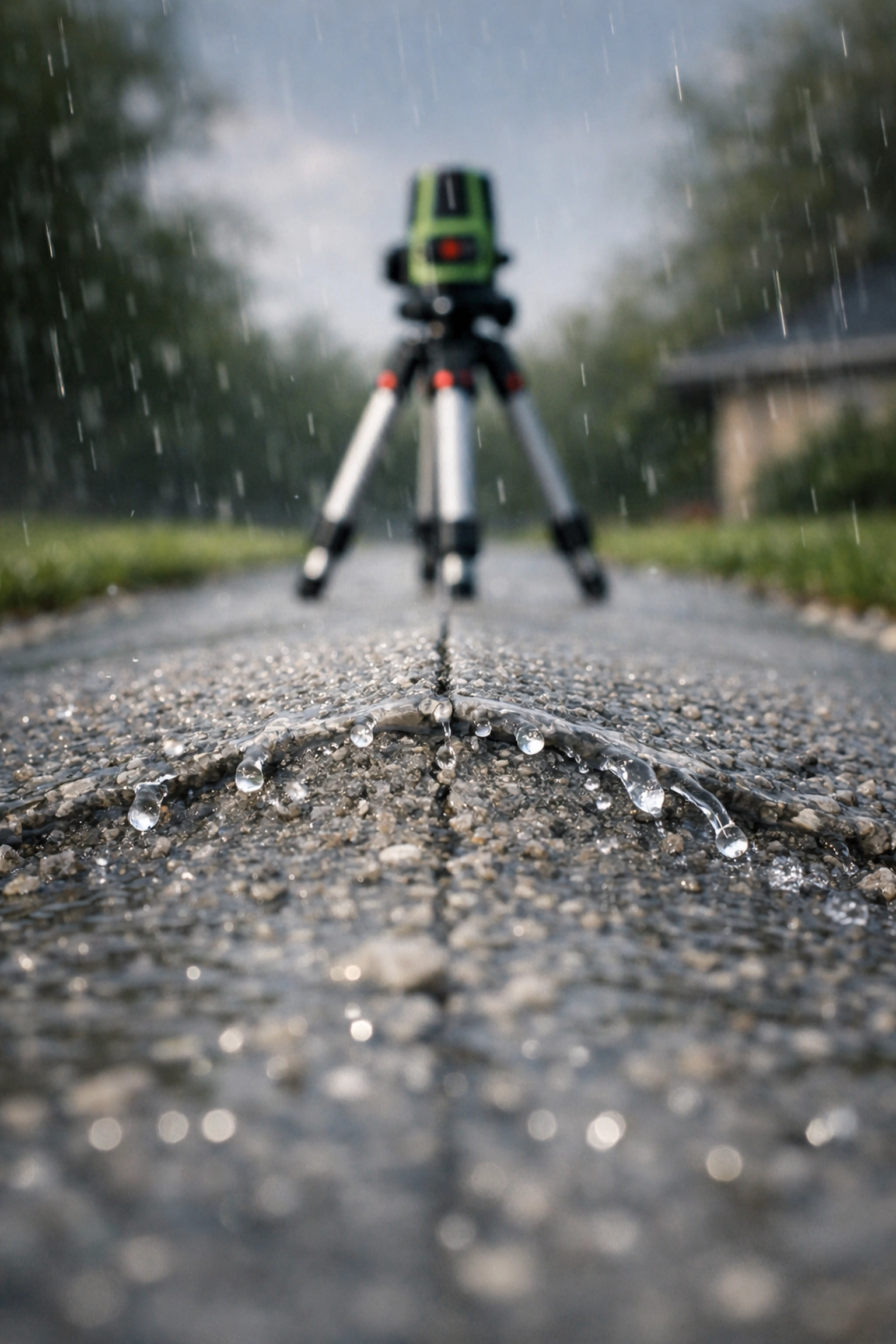
A flat driveway is a failing driveway. This is perhaps the most technical aspect of land management and where many DIY attempts or low-tier contractors fall short. Without a proper "crown," water will naturally settle in the center of the driveway, creating what is known as a "birdbath."
The 1/2-Inch Rule
In the world of precision excavation and land management, the "crown" refers to the center of the driveway being higher than the edges. For a standard 20-foot-wide driveway, the center should be approximately five inches higher than the outside edges. This creates a gentle slope of about 1/2 inch per foot.
Achieving this level of precision requires a keen eye and specialized tools. If the slope is too steep, the water will move too quickly, causing edge erosion. If it is too shallow, water will pool. Properly blending the edges with the center is a hallmark of top-tier driveway grading, ensuring a seamless transition that facilitates efficient drainage without compromising vehicle safety.
Pitfall #3: Using the Wrong Grading Patterns
There is a common misconception that grading is simply about dragging a blade in a straight line from point A to point B. However, straight-line grading often leads to a phenomenon known as "washboarding": those rhythmic, annoying ridges that cause your vehicle to vibrate and rattle.
Advanced Techniques for Smooth Surfaces
To provide a premier finish, professional operators utilize specific patterns based on the dimensions of the property:
- Serpentine Patterns: For narrower residential drives, moving the material in a winding, serpentine fashion helps to distribute the aggregate evenly and prevents the formation of longitudinal ruts.
- Overlapping Circular Patterns: For wider lots or commercial turnarounds, circular patterns ensure that the material is knit together from multiple angles, providing superior stability and a much smoother driving surface.
By avoiding the "straight-line trap," we eliminate the washboard effect and ensure that the surface is prepared to handle the heavy traffic common on Michigan properties.
Pitfall #4: Poor Aggregate Selection and Depth
Not all stone is created equal. A common pitfall for those searching for "driveway grading near me" is settling for a contractor who uses inferior or improper materials. Using a large, rounded stone might look nice for a few days, but it lacks the interlocking properties necessary for a stable driveway.
Choosing the Right Material
For a driveway to survive a Michigan rainy season, the aggregate must have a mix of sizes, including "fines" (dust-like particles) that act as a binder. Materials like 21AA crushed limestone or recycled concrete are often preferred because they pack tightly.
When B & G Outdoor Services manages a project, we ensure that the base layer is of sufficient depth: typically 4 to 6 inches: to provide a solid foundation. If the layer is too thin, the underlying soil will eventually mix with the gravel, leading to a "pumping" effect where mud is forced to the surface during rain events. You can learn more about identifying these issues in our guide on why driveway grading fails.
Pitfall #5: Skipping the Compaction Phase
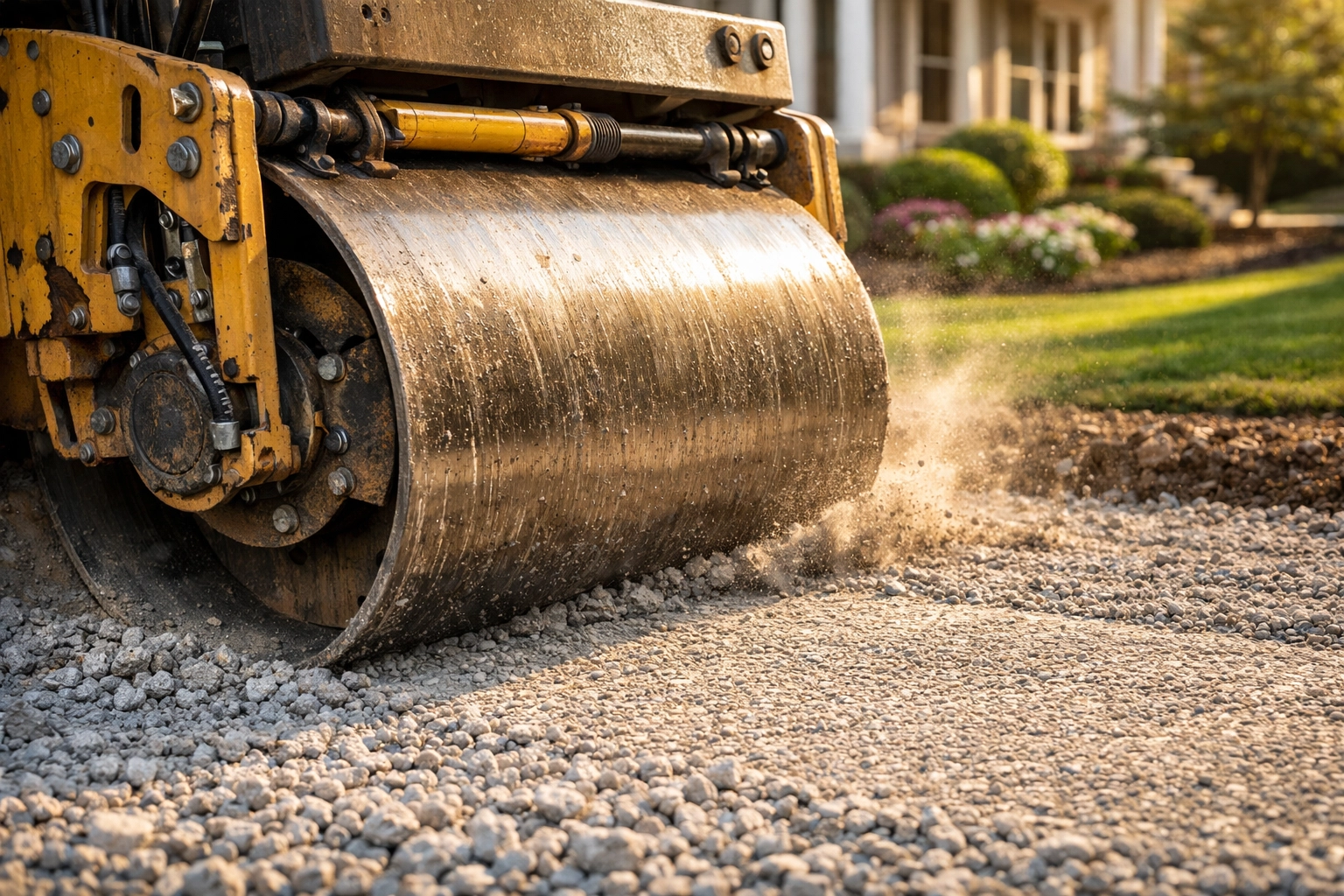
The final, and perhaps most vital, step in avoiding a driveway disaster is thorough compaction. Simply spreading gravel and letting car tires "pack it down" over time is a recipe for failure. During the rainy season, loose gravel acts like a sponge, soaking up water and allowing it to penetrate deep into the subgrade.
The Power of Professional Rolling
A premier grading service always concludes with the use of a heavy-duty vibratory roller. This state-of-the-art equipment exerts thousands of pounds of pressure, forcing the aggregate together and eliminating air pockets. The result is a dense, "paved-like" surface that resists water penetration and stands up to the heavy freeze-thaw cycles unique to our region. Proper compaction is the difference between a driveway that lasts for years and one that needs repair after the next big storm.
Environmental Responsibility and Safety
At B & G Outdoor Services, we take our role as a trusted partner in land management seriously. Beyond just the aesthetics of a smooth driveway, proper grading is an act of environmental responsibility. By controlling runoff, we prevent silt and sediment from entering local waterways and drainage systems. This precision also ensures that your property remains safe for emergency vehicles and delivery trucks, which can often be hindered by poor driveway conditions.
We pride ourselves on being adept at managing challenging terrain, delivering results that are both functional and environmentally sound. Whether you are dealing with a steep incline or a low-lying area prone to flooding, our team approaches every project with the same level of dedication to safety and precision.
Partner with the Experts at B & G Outdoor Services
Don't let Michigan's rainy season wash away your property's value. Attempting to manage grading without the proper expertise and equipment can lead to a cycle of frustration and wasted investment. Instead, rely on the premier provider of driveway grading near me.
Our team at B & G Outdoor Services is committed to delivering top-tier results on time and within budget. We understand the local soil conditions in Clarkston and the surrounding areas, and we have the skilled operators and state-of-the-art machinery necessary to do the job right the first time.
From initial site assessment to the final roll of the surface, we provide a comprehensive approach to land management that prioritizes your property’s longevity. If you are ready to reclaim your driveway and protect it against the elements, contact us today to experience the unparalleled service and precision that has made us a leader in the industry.
Ensure your property is pristine and ready for whatever the weather brings. Let B & G Outdoor Services be your trusted partner in maintaining a professional, well-maintained exterior.