
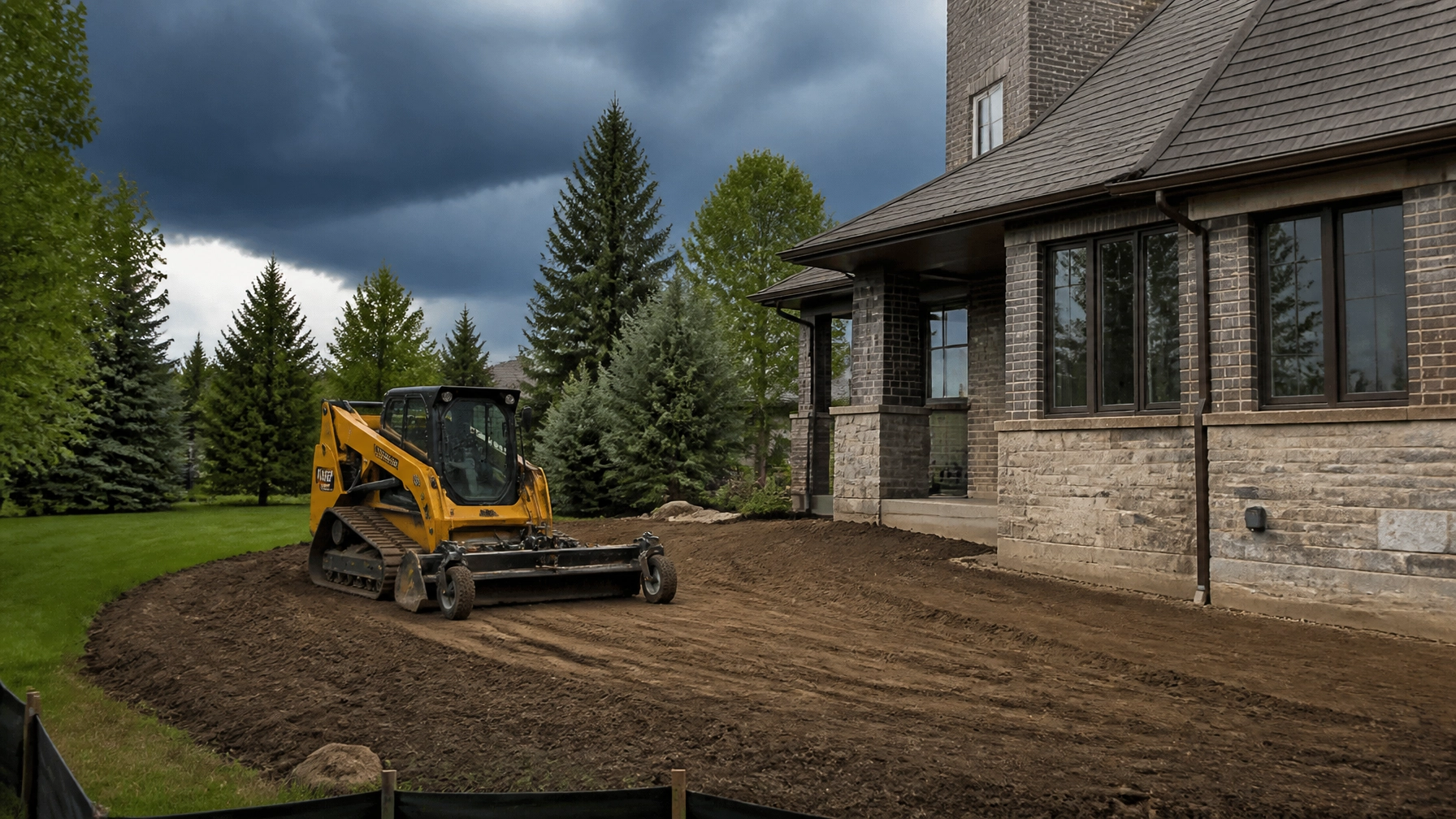
For homeowners in Clarkston, Michigan, the arrival of summer brings more than just sunshine and lake days. It also signals the season of sudden, torrential thunderstorms that can dump inches of rain in a matter of minutes. While most residents focus on their roof or gutters, the true hero: or villain: of home protection is the ground beneath their feet. Proper backyard grading is the premier defense against property damage, yet it is often the most misunderstood aspect of land management.
At B & G Outdoor Services, we have witnessed how minor oversights in land elevation can lead to catastrophic basement flooding and structural erosion. As a trusted partner in excavation and land management, we understand that precision is not just a preference; it is a necessity. Property owners can also explore the B & G Outdoor Services homepage to learn more about the company’s full range of outdoor property solutions. Below, we outline the seven most common grading mistakes Clarkston property owners make and the professional solutions required to safeguard your investment before the next storm cloud gathers.
1. The "Funnel" Effect: Sloping Toward the Foundation
The most fundamental rule of land management is that water must always move away from the structure. Unfortunately, many yards suffer from a "negative grade," where the earth inadvertently slopes toward the house. This creates a literal funnel, directing thousands of gallons of runoff directly against your foundation walls during a heavy Clarkston downpour.
Over time, this hydrostatic pressure can lead to cracks in the masonry and inevitable basement seepage. To rectify this, a premier grading solution involves establishing a minimum 2% to 5% slope away from the foundation for at least ten feet. Utilizing professional grading services ensures this slope is consistent and calculated, preventing the pooling that threatens your home's integrity.
2. Neglecting Downspout Discharge Zones
A common misconception is that a well-sloped yard can compensate for poorly placed downspouts. When your gutters collect the massive volume of water from a Clarkston summer storm and dump it just inches from your foundation, the most skilled grading in the world can be overwhelmed.

Many homeowners fail to extend their downspouts far enough to reach the designated drainage path. This mistake creates localized saturation zones that undermine the soil’s stability. The solution is two-fold: extend downspouts at least six to ten feet away from the home and ensure the discharge point is expertly graded to move that water toward a safe outlet, such as a swale or the street.
3. Using the Incorrect Soil Composition
Not all dirt is created equal. A frequent error in DIY grading is using standard, loose topsoil or sandy loam to fill low spots near the foundation. While excellent for gardening, these porous materials allow water to infiltrate quickly, leading it straight down to the basement walls rather than shedding it across the surface.
For effective foundation protection, top-tier professionals utilize "compactable fill": often a clay-based soil: that acts as a water-resistant barrier. At B & G Outdoor Services, we emphasize the use of high-quality materials that provide the density required to deflect runoff. Once the structural grade is established with fill dirt, only then should a thin layer of topsoil be applied for landscaping and lawn growth.
4. Skipping the Critical Compaction Phase
Even with the correct soil and the perfect slope, your grading project is destined for failure if you neglect compaction. Loose soil contains air pockets that will naturally settle over time, especially after a significant weather event. Without professional-grade compaction, your perfectly sloped yard can quickly develop "birdbaths" or depressions where water will sit and stagnate.
Achieving a stable, long-lasting grade requires the use of state-of-the-art equipment, such as plate compactors or vibratory rollers. By applying soil in thin "lifts" and compacting each layer, our team ensures that the land remains at the desired elevation, even under the weight of Michigan’s heaviest summer rains. This attention to detail is what separates a temporary fix from a permanent land management solution.
5. Failing to Design a Comprehensive Drainage Plan
Many property owners approach grading as a localized fix for a single puddle, rather than viewing the entire property as a singular hydraulic system. This "island" approach often results in moving a water problem from one side of the house to the other.

A sophisticated drainage plan considers natural water paths, existing vegetation, and the location of neighbors. It may involve the installation of swales: shallow, grass-lined channels: or French drains to manage persistent wet spots. Without a cohesive strategy, you risk violating local Clarkston drainage ordinances or inadvertently flooding a neighbor’s property, which can lead to costly legal disputes.
6. Attempting Major Grading Without Precision Equipment
While minor gardening can be a weekend hobby, the precision required for proper backyard grading necessitates industrial-grade technology. Manual raking and "eyeballing" the slope are insufficient for protecting a modern home.
B & G Outdoor Services utilizes advanced equipment, including laser-guided levels and heavy-duty excavators, to achieve unparalleled accuracy. Precision is particularly vital in Clarkston’s varied terrain, where challenging slopes and hidden rocks can complicate the process. By choosing a professional with the right tools, you ensure that the work is performed efficiently, safely, and: most importantly: correctly the first time. For more complex projects, you may want to review 10 reasons why driveway grading fails to understand how precision impacts all areas of your property.
7. Ignoring the "Environmental Responsibility" Factor
Improper grading doesn't just hurt your basement; it can damage the local ecosystem. Excessive runoff can lead to soil erosion, stripping away valuable nutrients and washing sediment into Clarkston’s pristine lakes and waterways. Furthermore, standing water caused by poor grading serves as a breeding ground for mosquitoes and other pests.
An expert grading project incorporates environmental responsibility by managing runoff in a way that promotes natural filtration. This might include the creation of a rain garden or the strategic planting of trees and shrubs to help absorb excess moisture. A well-graded yard is a healthy yard, providing a beautiful and functional space for your family to enjoy all summer long.

Secure Your Property with B & G Outdoor Services
The weather in Southeast Michigan is unpredictable, but your home’s safety shouldn't be. Don't wait for a flooded basement to realize that your backyard grading is insufficient. Whether you are dealing with persistent soggy spots or preparing for a major construction project, the team at B & G Outdoor Services is ready to provide the top-tier solutions you deserve.
Our skilled technicians are adept at managing challenging terrain and delivering high-quality results on time and within budget. We pride ourselves on being the premier partner for property owners in Clarkston, MI, offering everything from land clearing to precision grading and brush removal.
Ready to transform your backyard into a pristine, flood-resistant sanctuary? Contact B & G Outdoor Services today for a professional consultation. Let us put our state-of-the-art equipment and years of expertise to work for you, ensuring your property is ready for whatever the next summer storm brings.