By mid-August, many Clarkston homeowners are beginning to think about fall cleanup, winter maintenance, and the condition of their driveways before snow arrives. That preparation is wise, but one common misunderstanding can lead to expensive problems: driveway grading is not simply about making the surface look smooth. It is about controlling water.
The number-one mistake homeowners make is treating grading as a cosmetic repair rather than as part of the property’s overall drainage system. A driveway may appear level and attractive immediately after a quick surface scrape, yet still direct rainwater and snowmelt toward the garage, collect water in low spots, or allow moisture to weaken the base.
In Clarkston, where freeze-thaw cycles can place significant stress on gravel, asphalt, concrete, and soil, those drainage problems become especially serious during winter. Homeowners searching for “driveway grading near me” should look for a skilled, experienced partner who can evaluate where water comes from, where it is currently traveling, and where it needs to go.
The Real Purpose of Driveway Grading
Proper grading creates a controlled slope that moves water away from structures and toward a safe drainage area. That may include a lawn, swale, ditch, drainage channel, or another carefully selected outlet, depending on the property’s layout and soil conditions.
A driveway that is too flat may hold water in depressions, while a driveway with a negative grade may send runoff toward the garage or home. Neither issue is solved permanently by adding a thin layer of gravel or scraping the surface with light equipment.
Many driveway and site designs use a slope of approximately 2%, or about ¼ inch per foot, as a general drainage benchmark. However, the ideal grade depends on the driveway material, length, width, surrounding elevation, soil composition, and connection to the rest of the property. The Southeast Council of Governments driveway specifications and Michigan Department of Transportation driveway guidance illustrate why slope, drainage, and proper construction details matter.
The critical point is that the slope must be intentional. Water should not be left to find its own route.
Why Winter Exposes Poor Grading
During a Clarkston winter, water that remains trapped in a driveway does not simply disappear. It can soak into cracks, joints, loose aggregate, and the base beneath the driving surface. When temperatures fall, that moisture freezes and expands; when temperatures rise, it thaws and shifts through the weakened material.
Repeated freeze-thaw cycles can contribute to:
- Potholes and surface depressions
- Gravel migration and washouts
- Frost heaving and uneven areas
- Cracking along the edges or center of the driveway
- Ice formation near the garage door
- Soft, muddy shoulders
- Premature deterioration of the driveway base
- Runoff toward foundations, walkways, or neighboring properties
Snowplowing can intensify the problem. Plowed snow is often pushed toward the edges of a driveway, where it eventually melts. If the edges are poorly supported or the grade leads toward a low spot, the resulting water can saturate the surface and freeze again overnight.
A premier grading solution addresses these risks before the first major snowfall, rather than waiting until spring damage is visible.
The Homeowner Check to Perform After the Next Heavy Rain
Before scheduling repairs, homeowners can perform a simple visual inspection after a substantial summer storm. The goal is not to diagnose the entire driveway, but to identify signs that water is not moving as intended.
Walk the full length of the driveway and look for:
Standing water in the wheel paths
Repeated puddles often indicate depressions, insufficient crown, or a compromised base.Water collecting at the garage entrance
This can signal that the driveway falls toward the home instead of away from it.Washed-out gravel at the edges
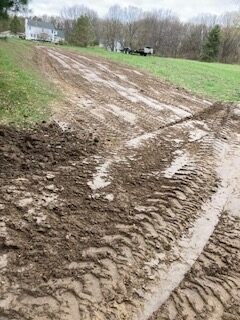
Erosion along the shoulders may mean that runoff is moving too quickly or that the edges lack support.Mud, soft spots, or visible rutting
These conditions suggest that water is entering the base or that the underlying soil is unstable.Downspouts or sump discharge flowing across the driveway
Concentrated water from a roof or foundation drainage system can quickly damage an otherwise serviceable surface.
Homeowners should also observe where the water travels after it leaves the driveway. A successful grade does not merely move water away from the garage; it directs that water toward a responsible outlet without creating erosion, flooding, or drainage concerns elsewhere on the property. This is an essential part of environmental responsibility and responsible land management.
Why Adding More Gravel Is Not Always the Answer
Adding gravel is sometimes appropriate, but it is not a universal solution. If the existing driveway has a poor slope, unstable subgrade, or drainage obstruction, new material may only cover the underlying issue temporarily.
A top layer of gravel can wash away if the driveway does not have proper containment and runoff control. It can also sink into soft soil if organic material, clay, or saturated subgrade remains beneath the surface. In other cases, repeated grading with the wrong equipment can move material around without correcting the actual elevation problem.
A durable driveway typically requires more than surface smoothing. The work may involve:
- Removing unsuitable organic material
- Reworking or stabilizing the subgrade
- Establishing a consistent crown or cross-slope
- Correcting a negative grade
- Reinforcing driveway shoulders
- Installing or improving swales
- Selecting aggregate appropriate for the site
- Compacting the finished surface properly
That is why professional grading services in Clarkston, MI begin with an evaluation rather than an assumption. The solution must be customized to the property.
What B & G Outdoor Services Brings to the Project
B & G Outdoor Services provides comprehensive excavation and grading solutions for homeowners, contractors, developers, and landowners throughout the Clarkston area. The company’s grading services are designed to create smooth, functional surfaces while improving drainage and preparing properties for long-term use.
The process begins with understanding the homeowner’s concerns, reviewing the driveway’s current condition, and assessing the surrounding terrain. From there, the company can determine whether the project requires surface regrading, excavation, gravel installation, shoulder correction, or a broader drainage strategy.
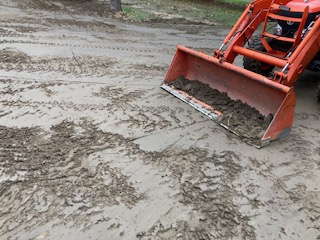
Using state-of-the-art equipment, the skilled team can efficiently reshape challenging terrain and produce a precise finished grade. Proper equipment matters because driveway correction may require cutting into compacted material, redistributing aggregate, removing unsuitable soil, and forming transitions that small residential tools cannot create consistently.
B & G Outdoor Services also understands that driveway work must fit into a larger property plan. If brush, overgrowth, or encroaching vegetation is affecting drainage, brush removal or fencerow clearing may be part of the most effective solution. If a new driveway or major site improvement is planned, excavation services can help establish a stable foundation before final grading and aggregate placement.

A Better Pre-Winter Driveway Plan
The best time to address grading concerns is before the ground freezes, snow accumulation limits access, and repeated winter weather exposes every weakness in the surface. Mid-August provides an excellent opportunity to inspect the driveway, identify drainage problems, and plan corrective work while conditions remain favorable.
A reliable pre-winter plan may include:
- Inspecting the driveway after heavy rain
- Checking whether water flows away from the home
- Clearing brush and debris from drainage paths
- Repairing potholes and low areas
- Restoring the driveway crown or cross-slope
- Improving gravel shoulders and transitions
- Confirming that downspouts do not discharge across the driveway
- Scheduling professional grading before late-fall weather arrives
This proactive approach is safer, more efficient, and often more cost-effective than waiting for spring repairs. It also gives the homeowner time to receive a clear project scope, understand the recommended materials, and plan for work to be completed on time and within budget.

Do Not Let a Cosmetic Fix Become a Winter Repair
The driveway may look acceptable today, but appearance alone does not confirm that water is moving correctly. A smooth surface with a weak base or improper slope can still develop ice, potholes, washouts, and structural damage once winter arrives.
The #1 thing Clarkston homeowners get wrong is assuming that driveway grading means simply leveling the visible surface. In reality, proper grading is a precise drainage solution that protects access, supports driveway longevity, and helps safeguard the surrounding property.
Our team at B & G Outdoor Services is ready to evaluate your driveway, correct drainage concerns, and create a pristine, well-maintained surface that is prepared for Michigan’s winter conditions. Our services are customized to the terrain, completed with advanced equipment, and delivered with reliable communication from start to finish.
If you are searching for driveway grading near me or dependable grading services in Clarkston, MI, contact B & G Outdoor Services today to schedule a consultation. A winter-ready driveway begins with the right grade.